
Entertainment Center with Fireplace and Bookshelves
A complete guide to designing, choosing, and installing a fireplace entertainment center with built-in bookshelves for your living room, media room, or family space.
What Is an Entertainment Center with Fireplace and Bookshelves?
An entertainment center with a fireplace and bookshelves is a single, unified wall unit that combines three functions in one structure: a media zone for your television and audio equipment, a heating or ambiance zone with a fireplace, and a storage or display zone with open or closed shelving. Instead of treating the TV, the fireplace, and the bookshelf as three separate pieces of furniture, this design blends them into one focal wall.
This layout is especially common in living rooms, family rooms, and finished basements, where homeowners want a clean, built-in look rather than a cluttered mix of freestanding cabinets. The fireplace can be electric, gas, or even a wood-burning insert, depending on the existing chimney and ventilation of the room. The bookshelves may flank the fireplace on both sides, sit above it, or wrap the entire wall from floor to ceiling.
Because the unit is often the largest piece of furniture in the room, it strongly influences the style of the whole space. A modern entertainment center with clean lines and a linear electric fireplace feels very different from a traditional wall unit with a wood-burning firebox and heavy crown molding. That flexibility is exactly why this concept works in so many homes.
If you are still exploring the broader design language of your room, you may want to review general fireplace design ideas with pictures and a fireplace design styles guide before committing to a specific layout.
Why Entertainment Centers with Fireplace and Bookshelves Are So Popular
There are several practical and emotional reasons why this combination has become a staple in American homes.
- One focal point instead of three. The eye is drawn to a single, organized wall instead of scattered furniture. This makes the room feel calmer and more intentional.
- Space efficiency. A wall unit uses vertical space, which is precious in smaller living rooms. Instead of a separate TV stand, a separate shelf, and a separate fireplace, you get one footprint.
- Cable and component management. Built-in units can hide wires, media players, and gaming consoles behind doors or in dedicated bays, which keeps the room looking tidy.
- Increased home value. A well-executed built-in wall unit is often perceived as a permanent upgrade, similar to custom cabinetry. Many buyers see it as a feature, not a drawback.
- Warmth and ambiance. The fireplace adds a psychological anchor to the room. Even an electric fireplace with a realistic flame effect changes how the space feels in the evening.
- Display and storage. Bookshelves give you a place for books, photo frames, plants, and decorative objects, which personalizes the room without adding clutter to other surfaces.
Design tip: If your goal is ambiance more than heating, an electric fireplace insert is often the simplest choice because it needs no venting and can be placed almost anywhere in the wall unit. If you want real heat and already have a gas line or chimney, a gas or wood-burning option may be more satisfying. Compare the trade-offs in our electric vs gas fireplace guide and the broader types of fireplaces explained article.
Fireplace Options for Your Entertainment Wall
The fireplace you choose determines the venting, clearance, and electrical requirements of the entire unit. Here are the main options and how they fit into an entertainment center.
Electric Fireplace Inserts
Electric inserts are the most flexible option for a media wall. They typically require only a standard electrical outlet, produce no combustion byproducts, and can be installed in a framed opening with minimal clearance. Many models include a heater, a flame-only mode, and a remote control. They are ideal for apartments, basements, and rooms without a chimney. For a deeper look at placement, see electric fireplace insert for entertainment center and electric fireplace with bookshelves.
Gas Fireplace Inserts
Gas inserts produce a realistic flame and meaningful heat, but they require a gas line and either a vent or a ventless design. Direct-vent models are sealed and efficient, while ventless models are simpler to install but have stricter clearance and room-size requirements. If you already have a gas line or an existing wood-burning fireplace, a gas insert can be a strong upgrade. See gas fireplace insert and gas fireplace requirements for details.
Wood-Burning Inserts and Stoves
Wood-burning options offer the most traditional experience, but they require a chimney or a properly rated flue, regular cleaning, and more clearance to combustibles. They are rarely the first choice for a TV-centric wall because of heat and soot concerns, but they can work in a large room with careful planning. Learn more in wood-burning fireplace insert with blower and fireplace venting requirements.
Ethanol and Water Vapor Fireplaces
Ethanol fireplaces burn cleanly and need no vent, but they produce real flames and consume fuel, so they require attention to clearance and air quality. Water vapor (sometimes called vapor) fireplaces use LED light and mist to simulate flames with no heat and no venting, which makes them very safe for media walls. They are a niche but growing category.
| Fireplace Type | Venting Needed | Heat Output | Best Fit for Media Wall |
|---|---|---|---|
| Electric insert | No | Low to moderate | Apartments, basements, retrofit walls |
| Gas insert (direct vent) | Yes | Moderate to high | Rooms with gas line and exterior wall access |
| Gas insert (ventless) | No | Moderate | Rooms with adequate volume and code approval |
| Wood insert | Yes (chimney/flue) | High | Large rooms with existing chimney |
| Ethanol | No | Low | Ambiance-focused walls |
| Water vapor | No | None (flame only) | TV walls where heat is not desired |
For heating expectations by room size, the fireplace heating capacity and BTU guide and the electric fireplace heating capacity and BTU guide are useful references.
Design Ideas and Layouts for Fireplace Entertainment Centers
Once you know which fireplace type is realistic for your room, the next decision is layout. The three most common arrangements are:
1. Fireplace in the Center, TV Above, Shelves on Both Sides
This is the classic symmetric layout. The fireplace sits low in the center, the TV is mounted above it, and matching bookshelves flank both sides. It creates a balanced, formal look that works well in traditional and transitional rooms. The main drawback is that the TV is higher than ideal for viewing, so consider a tilting mount and check the recommended viewing height. Our TV above fireplace safety guide covers heat and height concerns.
2. TV in the Center, Fireplace Below or Beside
If the TV is the priority, place it at eye level and put the fireplace below it in a low cabinet, or offset the fireplace to one side. A linear electric fireplace under a TV is a popular solution because it adds ambiance without pushing the screen too high. See electric fireplace TV stand with bookshelves and TV entertainment center with electric fireplace for examples.
3. Asymmetric Layout with Open Shelving
An asymmetric design places the fireplace on one side, the TV on the other, and uses open shelves to connect them. This feels more casual and modern and can adapt to awkward wall dimensions. Floating shelves on both sides of a fireplace are a lighter alternative to full cabinets; see fireplace with floating shelves on both sides.
Style Directions
- Modern / contemporary: flat-panel fronts, linear fireplace, minimal hardware, integrated LED lighting.
- Farmhouse: white or off-white cabinetry, shiplap or beadboard back, barn doors, rustic wood shelves. See farmhouse fireplace ideas.
- Traditional: stained wood, crown molding, raised hearth, symmetrical columns.
- Industrial: metal framing, reclaimed wood, exposed brick accents.
For more wall-focused inspiration, browse fireplace accent wall ideas and fireplace wall units entertainment center.
Sizing Your TV, Fireplace, and Bookshelves
Getting the proportions right is what separates a custom-looking wall from a clumsy one. Use these rules of thumb as a starting point.
Television Size and Height
Match the TV size to the seating distance. A common guideline is that the screen diagonal should be roughly one-third to one-half of the viewing distance in inches. For a 10-foot viewing distance, a 55-inch to 65-inch TV is comfortable; for 12 feet, a 65-inch to 75-inch TV is typical. The center of the screen should sit near seated eye level, roughly 42 to 48 inches from the floor. If the TV must go above the fireplace, keep the fireplace low-profile and use a tilt mount.
Fireplace Size
For a linear electric fireplace, a width between 40 and 60 inches is common under a TV, while 60 to 80 inches creates a dramatic focal point. For a traditional firebox, a 30 to 36 inch opening is typical in a media wall. The fireplace should not dominate the TV or vice versa; visually, the fireplace often reads best when its width is similar to or slightly wider than the TV.
Bookshelf Depth and Height
Standard upper shelving is 10 to 12 inches deep, while base cabinets are 18 to 24 inches deep to house components. Shelf spacing of 12 to 15 inches fits most books and decorative objects. If you plan to display tall items, include at least one shelf with 18 inches of clearance. For floor-to-ceiling units, a 96-inch overall height is common in rooms with 8-foot ceilings, leaving room for trim.
Proportion tip: The fireplace and TV should not be the same width and stacked directly, or the wall can look like a stack of boxes. Either make the fireplace wider, or break the symmetry with shelving or a mantel line. Learn more about room fit in matching fireplace proportions to room shape and fireplace sizing for open concept rooms.
Built-In vs Freestanding Entertainment Centers
There are two broad approaches, and each has real trade-offs.
Built-In Units
A built-in unit is framed into the wall or constructed as permanent cabinetry. It offers the cleanest look, the best use of space, and the highest perceived value. It also allows you to recess the TV and hide wiring completely. The downsides are higher complexity, longer installation time, and the fact that it is difficult to move or reconfigure later. Built-ins are usually the right choice when you plan to stay in the home and want a custom focal wall.
Freestanding and Modular Units
Freestanding TV stands with an integrated fireplace, and modular wall units that assemble from panels, are easier to install and can be relocated. They are a good fit for renters, apartments, and homeowners who want to test a layout before committing. The trade-off is that they often look less integrated and may leave gaps against the wall. Many budget-friendly and mid-range options fall into this category. See electric fireplace TV stand and fireplace TV stand with shelves.
| Factor | Built-In | Freestanding / Modular |
|---|---|---|
| Look | Custom, seamless | Furniture-like, may show gaps |
| Installation | Complex, often professional | Simple, often DIY |
| Portability | Permanent | Relocatable |
| Wiring management | Excellent (in-wall) | Limited (surface or behind unit) |
| Best for | Long-term homeowners | Renters, apartments, flexible layouts |
For a deeper comparison of installation styles, see built-in vs freestanding fireplace and wall-mounted vs insert vs freestanding fireplace.
Safety, Clearance, and Ventilation
Safety requirements vary by fireplace type, but a few principles apply to every entertainment center with a fireplace.
- Follow the manufacturer's clearance chart. Every fireplace lists minimum distances to combustibles above, below, and to the sides. These are not suggestions. Built-in cabinetry must respect them.
- Keep the TV out of the heat zone. Heat rises. If the TV is above the fireplace, use a mantel or heat shield to deflect warm air, and check the TV's maximum operating temperature. See fireplace mantel heat shield and fireplace heat shield.
- Ventilate electronics. Media components and game consoles generate heat. Include open backs or vents in cabinets, and avoid sealing them in tight boxes.
- Respect furniture distance. Keep upholstered furniture and curtains at a safe distance from the firebox. Guidelines are in how close can furniture be to a fireplace.
- Install detectors. For any combustion fireplace, place a carbon monoxide detector nearby, and keep a fire extinguisher near the fireplace.
- Use a screen or glass doors. This is especially important with wood-burning fireplaces. See fireplace screen with glass doors.
For a broader checklist, review the fireplace safety guide and electric fireplace safety tips.
Installation and Setup
The installation path depends on whether you are building new cabinetry or placing a freestanding unit.
Planning Phase
- Measure the wall and confirm the TV size, fireplace size, and shelf layout.
- Identify electrical outlets, gas lines, and any existing chimney or vent.
- Check local building codes, especially for gas and wood-burning appliances. Permits may be required; see fireplace permit requirements.
- Decide whether the work is DIY-friendly or needs a professional. Our DIY vs professional fireplace installation guide helps with that call.
Electric Fireplace Installation
Electric inserts are the most DIY-friendly. In most cases, you frame an opening, run a dedicated circuit if required, and slide the insert into place. Many plug-in models simply need an outlet nearby. Step-by-step details are in electric fireplace installation plug and play and installing electric fireplace into existing fireplace.
Gas Fireplace Installation
Gas work should be done by a licensed technician. The unit needs a gas supply, proper venting or ventless approval, and clearance to combustibles. See gas fireplace installation requirements and installing gas fireplace insert in existing fireplace.
Freestanding Unit Setup
Modular and freestanding units usually arrive in panels with hardware and instructions. The main tasks are leveling, anchoring to the wall for tip-over safety, and routing cables. Allow a few hours for assembly and a full day if you are also mounting a TV and managing wiring.
Maintenance Tips for Fireplace Entertainment Centers
A media wall collects dust in places that are easy to forget. A simple routine keeps it looking new and safe.
- Dust shelves and electronics weekly. Use a microfiber cloth and avoid spraying cleaner directly on components.
- Clean the fireplace glass. Soot and film build up on gas and wood fireplace glass. See how to clean fireplace glass and fireplace glass cleaner.
- Vacuum vents and blowers. Dust reduces airflow and can cause overheating. Guidance is in cleaning electric fireplace and fireplace blower fan guide.
- Inspect annually. Even electric units benefit from a yearly check of cords, plugs, and mounting. Use the fireplace inspection checklist and DIY fireplace inspection checklist.
- Seasonal care. Follow the seasonal fireplace checklist and monthly and yearly maintenance schedule.
Type-specific routines are covered in electric fireplace maintenance, gas fireplace maintenance, and wood fireplace maintenance.
Ready to Compare Real Products?
Once you know your fireplace type, layout, and size, the next step is comparing specific models. The recommendations below are grouped for entertainment center use.
See Recommended Entertainment CentersFrequently Asked Questions
Can I put a TV above an electric fireplace in an entertainment center?
Yes, this is one of the most common configurations. Electric fireplaces emit less heat than gas or wood, and many models can run flame-only with no heat. Still, check the manufacturer's clearance and use a mantel or heat shield if needed. See TV above fireplace safety.
What is the best fireplace type for a media wall?
Electric inserts are the most flexible because they need no venting and have modest clearance requirements. Gas inserts are a good upgrade if you have a gas line and want more realistic flame and heat. Wood-burning is rarely ideal for a TV wall because of heat and soot.
How wide should the bookshelves be?
Shelf width depends on the wall. Aim for balanced proportions: each side shelf should be wide enough to hold books and decor without looking cramped. A common approach is 18 to 36 inches of shelf width per side. Deeper base cabinets of 18 to 24 inches can hold media components.
Do built-in entertainment centers add home value?
They often do, especially when they are well-designed and match the home's style. A quality built-in can be seen as a permanent feature. However, overly specific or outdated designs can date the space. See does a fireplace add value to your home for related context.
Can I convert an existing wood-burning fireplace into an entertainment center?
Yes, many homeowners convert an old wood-burning fireplace to electric or gas to simplify venting and reduce maintenance. Electric is the simplest retrofit. Gas requires a line and venting. See converting wood-burning fireplace to electric and electric fireplace insert for wood-burning fireplace.
How do I hide cables in an entertainment center with a fireplace?
Built-in units can route cables behind the wall or through cabinet grommets. Freestanding units can use cable management channels, zip ties, and adhesive clips. If you are building new cabinetry, plan an accessible equipment bay with ventilation and a power outlet inside.
Recommended Entertainment Centers with Fireplace and Bookshelves
⚠️ AFFILIATE DISCLOSURE: This website contains affiliate links. As an Amazon Associate, we earn from qualifying purchases. If you make a purchase through these links, we may receive a small commission at no additional cost to you. Read our full affiliate policy.

Breezestival Black Farmhouse TV Stand with Fireplace, Entertainment Center, 98" Wall Unit Media Console with Bookshelf, Cabinet & Power Outlets & Barn Doors, Fits TVs Up to 75” for Living Room
Check price on Amazon
OneBlis 98" Farmhouse TV Stand with 36" Electric Fireplace, Large Entertainment Center, Wall Unit Media Console with Bookshelves, Barn Doors, Fits TVs Up to 75” for Living Room, Grey
Check price on Amazon
St.Mandyu 107" Wall Unit Entertainment Center with Fireplace for 85 inch TV, Modern High Glossy TV Stand with LED Lights, Media Console with Wine Storage & Bookshelves,Black
Check price on Amazon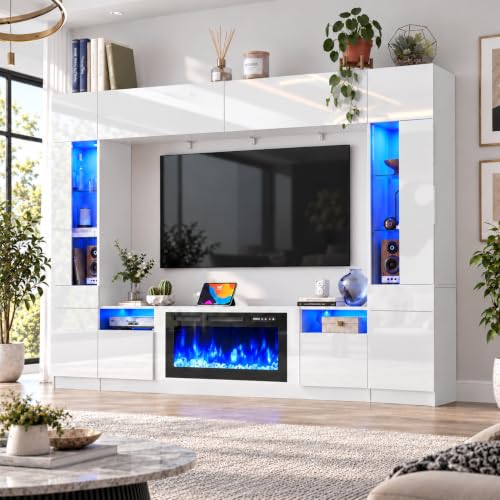
St.Mandyu 107" Wall Unit Entertainment Center with Fireplace for 85 inch TV, Modern High Glossy TV Stand with LED Lights, Media Console with Wine Storage & Bookshelves,White
Check price on Amazon
MaiDeHaoo White Farmhouse TV Stand with Fireplace, Large Entertainment Center with Bookshelves, Glass Doors & Adjustable Shelves, 95.5" Wall Unit Media Console for TVs up to 80"
Check price on Amazon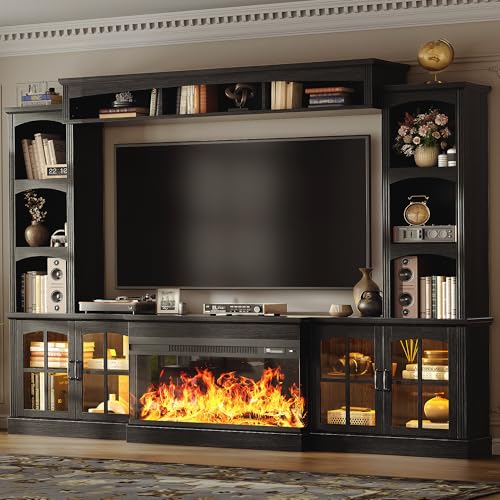
OneBlis 98" Wall Unit TV Stand with 36" Electric Fireplace, Black | Large Entertainment Center, Farmhouse Style with Bookshelves, Barn Doors, Fits TVs Up to 75", For Living Room
Check price on Amazon
Virubi 95.5" Farmhouse Entertainment Center with Fireplace,Wood Large TV Stand Wall Unit Media Console with Storage Bookshelves, Glass Doors & Adjustable Shelves, for Living Room (Navy Blue,95.5 in)
Check price on Amazon