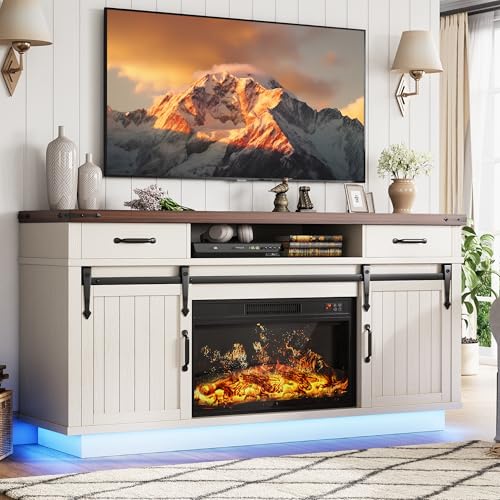
Entertainment Center with Fireplace and Barn Doors
The complete guide to choosing, sizing, and styling a barn door entertainment center with a built-in fireplace for your living room — rustic charm meets modern function.
📋 What You'll Learn
- What Is an Entertainment Center with Fireplace and Barn Doors?
- Why This Design Is So Popular
- Types of Barn Door Entertainment Centers
- Fireplace Options: Electric, Gas, or Wood
- How to Choose the Right Size
- Style and Material Considerations
- Installation and Setup Guide
- Pros and Cons
- Buying Tips and Tier Guide
- Frequently Asked Questions
What Is an Entertainment Center with Fireplace and Barn Doors?
An entertainment center with fireplace and barn doors is a multifunctional furniture piece that combines three major living room elements into one cohesive unit: a television mount, a built-in fireplace, and sliding barn-style doors for storage and concealment. The barn doors typically glide along a visible metal track — often in a matte black or brushed steel finish — and can be positioned to hide the TV when not in use or to reveal shelving and media storage.
This design sits at the intersection of farmhouse style and modern functionality. It solves a common living room dilemma: how to incorporate a fireplace and a TV without making the wall feel cluttered or unbalanced. The sliding doors add a tactile, architectural element that hinged cabinet doors simply cannot match. For homeowners exploring built-in entertainment center with fireplace designs, the barn door variant is often the most visually striking option.
Unlike a traditional built-in entertainment center with electric fireplace, which is permanently framed into the wall, a barn door entertainment center can be freestanding or semi-built-in. This flexibility makes it suitable for renters, homeowners in historic properties, and anyone who wants the look without major renovation work.
Why This Design Is So Popular
The combination of barn doors and a fireplace taps into several design trends that have dominated American living rooms for the past decade. Here's why this configuration continues to grow in popularity:
- Space efficiency: Sliding barn doors move parallel to the wall rather than swinging outward, which preserves valuable floor space. In smaller living rooms, this is a significant advantage over traditional hinged cabinets.
- Concealment flexibility: The doors let you hide the TV, media components, or messy shelves instantly — useful when hosting guests or when you want the fireplace to be the focal point.
- Rustic aesthetic: The exposed track and wood-paneled doors bring warmth and texture that complements both farmhouse mantel decorating ideas and more contemporary interiors.
- Integrated heating: An electric or gas fireplace adds supplemental warmth and ambiance, making the unit functional beyond just storage and display.
- Focal point creation: The combined height and width of the unit creates a natural anchor for the room, simplifying furniture arrangement.
Types of Barn Door Entertainment Centers
Not all barn door entertainment centers are built the same way. The three main configurations differ in how they're installed, how much space they occupy, and how much flexibility they offer.
1. Freestanding Barn Door Entertainment Center
This is the most common and accessible option. The unit arrives as flat-pack furniture and assembles with basic tools. It sits against the wall like a traditional TV stand but includes a fireplace insert and sliding doors. Freestanding units are ideal for renters or anyone who may want to rearrange the room later. Many models include adjustable shelving and cable management cutouts.
2. Built-In Barn Door Entertainment Center
A built-in version is framed into the wall or constructed as permanent cabinetry. The barn doors still slide on a track, but the surrounding structure is finished with drywall, shiplap, or wood paneling. This approach offers a seamless look and maximizes storage. It's the preferred choice for new construction or major renovations. If you're considering this route, review our guide on DIY built-in entertainment center with fireplace for planning considerations.
3. Corner Barn Door Entertainment Center
Corner units are designed to fit into a 90-degree wall junction, making them useful in rooms where wall space is limited. The barn doors on corner models are typically narrower and may slide in a single direction. These are a smart solution for design ideas for small living room with fireplace where every inch counts.
4. Wall-Mounted Barn Door Entertainment Center
Wall-mounted versions float above the floor, with the fireplace and shelving suspended on a heavy-duty bracket system. This creates a modern, airy look and makes floor cleaning easier. However, wall-mounted units require secure anchoring into studs and are generally not suitable for heavy CRT-era components.
Fireplace Options: Electric, Gas, or Wood
The fireplace you choose for your entertainment center affects installation complexity, heating output, maintenance, and safety. Here's how the three main options compare in the context of a barn door entertainment center.
| Feature | Electric | Gas | Wood |
|---|---|---|---|
| Venting Required | None | Yes (vented) or No (ventless) | Yes — chimney or flue |
| Installation Complexity | Plug-in or hardwired | Professional required | Professional required |
| Heat Output | Supplemental (zone heating) | Moderate to high | High |
| Maintenance | Minimal — dust and inspect | Annual inspection | Frequent — ash, creosote, chimney |
| TV Above Fireplace | Safe with clearance | Limited — heat rises | Not recommended |
| Best For | Renters, apartments, easy install | Whole-room heating, realism | Traditional ambiance, off-grid |
For most entertainment center applications, electric fireplaces are the practical choice. They require no venting, produce no carbon monoxide, and can be plugged into a standard outlet (though some high-output models benefit from a dedicated circuit). If you want the most realistic flame appearance, look for models with realistic electric fireplace with crackling sound features.
Gas fireplaces offer superior heating and a more authentic flame, but they require a gas line and professional installation. Ventless gas models are an option, but they produce moisture and require oxygen depletion sensors. If you're considering a gas insert, review the gas fireplace installation requirements before committing.
Wood-burning fireplaces are rarely integrated into entertainment centers because of clearance requirements, chimney needs, and ash management. However, if your home already has a wood-burning fireplace, you might consider a wood-burning fireplace insert with glass doors as a separate installation, with the entertainment center built around it.
How to Choose the Right Size
Getting the proportions right is the difference between a furniture piece that looks intentional and one that looks like an afterthought. Use these guidelines to match the entertainment center to your TV and room.
Matching the Unit to Your TV Size
The general rule is that the entertainment center should be at least 6 to 9 inches wider than the TV on each side. This creates visual balance and prevents the TV from looking like it's overflowing the furniture.
| TV Size | TV Width (approx.) | Recommended Unit Width |
|---|---|---|
| 55 inch | 48 inches | 58–65 inches |
| 65 inch | 57 inches | 68–75 inches |
| 75 inch | 66 inches | 76–85 inches |
| 85 inch | 74 inches | 85–95 inches |
If you're working with a specific TV size, we have dedicated guides for the most common configurations: entertainment center with fireplace for 65-inch TV, entertainment center with fireplace for 75-inch TV, and entertainment center for 85-inch TV with fireplace.
Height Considerations
The ideal viewing height places the center of the TV at eye level when seated — typically 42 to 48 inches from the floor. If your entertainment center has a fireplace below the TV, check the manufacturer's clearance requirements. Electric fireplaces generally require 12 inches of clearance between the top of the firebox and the bottom of the TV, though some models allow less.
Room Proportion
In a room with 8-foot ceilings, an entertainment center that is 72 to 80 inches tall will feel substantial without overwhelming the space. For rooms with 9-foot or higher ceilings, units up to 90 inches tall can work well. The width of the unit should be roughly 60 to 75 percent of the wall it occupies — anything narrower looks lost, and anything wider crowds the space.
Style and Material Considerations
The barn door entertainment center is available in a range of finishes and materials. Your choice should complement the existing architecture and furniture in the room.
Wood Species and Finish
- Pine and fir: Light, knotty, and affordable. Often used for rustic or farmhouse styles. Takes paint and stain well.
- Oak: Durable with visible grain. Works in traditional and transitional interiors. Often stained in honey, walnut, or espresso tones.
- Cherry: Rich, reddish-brown tone that darkens with age. A cherry wood entertainment center with fireplace reads as premium and traditional.
- Engineered wood with veneer: Common in mid-range and entry-level units. Consistent appearance, lower cost, but less repairable than solid wood.
- Metal accents: The barn door track is typically steel or aluminum. Matte black is the most popular finish, though galvanized and brass options exist.
Barn Door Styles
- Classic X-brace: The most recognizable barn door pattern. Diagonal braces form an X across the door face.
- Z-brace: A simpler pattern with diagonal and horizontal braces. Common in modern farmhouse designs.
- Paneled: Recessed or raised panels without diagonal bracing. Reads as more formal.
- Glass-front: Some models combine barn door hardware with glass panels, allowing display of items while still sliding.
- Mirrored: Less common, but mirrored barn doors can make a room feel larger.
Color Coordination
White and off-white finishes dominate the farmhouse category and pair well with white farmhouse entertainment center with fireplace styling. Black and charcoal units are popular in modern and industrial interiors. Natural wood tones work in rustic and transitional spaces.
If your room already has a red brick fireplace, choose a finish that contrasts rather than competes — white, cream, or deep charcoal are safer choices than warm wood tones that clash with the brick.
Installation and Setup Guide
Installation complexity depends on whether you choose a freestanding, built-in, or wall-mounted unit. Here's what to expect for each.
Freestanding Assembly
Most freestanding entertainment centers ship flat and require assembly. Typical steps include:
- Unpack and sort all hardware and panels.
- Assemble the base and side panels according to the instructions.
- Install the fireplace insert into its designated cavity.
- Attach the top and back panels.
- Mount the barn door track and hang the doors.
- Adjust door alignment and add felt pads or stoppers.
- Secure the unit to the wall with the included anti-tip strap.
Two people can typically complete this in 2 to 4 hours. No special tools are required beyond a screwdriver, hammer, and possibly a drill.
Built-In Installation
A built-in unit is framed into the wall or constructed as custom cabinetry. This requires measuring the cavity, framing, electrical work (for the fireplace and any lighting), and finishing. Professional installation is strongly recommended. Expect the project to take several days to a week depending on complexity.
If you're planning a built-in, review the fireplace installation guide overview for a broader planning framework.
Electrical Considerations
Electric fireplaces draw between 750 and 1,500 watts. A standard 15-amp household circuit can handle a 1,500-watt fireplace, but if the same circuit powers other appliances, you may trip the breaker. For best results, use a dedicated circuit or a 20-amp circuit. If you're unsure, consult a licensed electrician.
Many electric fireplaces include a remote control. If yours doesn't, or if the remote is lost, a universal remote control for electric fireplace can restore convenience.
Safety Clearances
- Keep flammable materials at least 3 feet from the front of the fireplace.
- Maintain the manufacturer's specified clearance above the firebox for TV mounting.
- Do not block ventilation openings on electric fireplaces.
- Anchor all freestanding units to the wall to prevent tipping.
For more safety guidance, see furniture distance from fireplace.
Pros and Cons of Barn Door Entertainment Centers
No furniture piece is perfect for every situation. Here's an honest look at the advantages and drawbacks.
✅ Advantages
- Sliding doors save floor space compared to hinged cabinets
- Conceals TV and media clutter when not in use
- Integrated fireplace adds warmth and ambiance
- Strong visual focal point for the living room
- Available in freestanding, built-in, and corner configurations
- No venting required for electric models
- Complements farmhouse, rustic, and modern farmhouse styles
⚠️ Drawbacks
- Barn door hardware requires periodic adjustment
- Freestanding units may have limited weight capacity
- Fireplace heat output is supplemental, not primary
- Built-in versions require significant renovation
- Doors may rattle or stick if the track is misaligned
- Limited depth for deep media components
- Premium models represent a significant investment
For homeowners who value both aesthetics and function, the advantages typically outweigh the drawbacks. The key is choosing the right tier of product for your needs and ensuring proper installation.
Buying Tips and Tier Guide
Entertainment centers with fireplaces and barn doors span a wide range of quality and capability. Rather than focusing on specific prices, it's more useful to understand the tiers of product available and what each tier typically offers.
Entry-Level / Budget-Friendly
- Engineered wood or particle board construction with laminate finish
- Basic electric fireplace insert with simple on/off heat control
- Barn doors may be lighter weight and track hardware less refined
- Limited shelving adjustability
- Assembly required — usually straightforward
- Best for: Renters, guest rooms, occasional use
Mid-Range / Mid-Tier
- Solid wood and veneer construction (often pine, oak, or acacia)
- Electric fireplace with thermostat, remote control, and multiple flame settings
- Smoother-gliding barn door hardware with better weight capacity
- Adjustable shelving and cable management features
- Available in multiple finishes and sizes
- Best for: Primary living rooms, daily use, homeowners
Premium / High-End
- Solid hardwood construction (cherry, maple, or high-grade oak)
- Realistic electric fireplace with crackling sound, multi-color flames, and zone heating
- Heavy-duty steel barn door track with soft-close or slow-close mechanisms
- Custom sizing and finish options
- Superior fit and finish — dovetail joints, full-extension drawer glides
- Best for: Custom homes, design-focused interiors, long-term investment
Luxury / Top-Tier
- Built-in or custom cabinetry designed specifically for the space
- Premium gas or high-output electric fireplace options
- Integrated lighting, smart home connectivity, and motorized barn doors
- Architectural-grade materials and finishes
- Designed and installed by professionals
- Best for: High-end renovations, custom builds, whole-home design projects
Before purchasing, verify the fireplace's heat output and whether it meets your room's needs. Our fireplace heating capacity BTU guide explains how to calculate the right size for your space.
Ready to Transform Your Living Room?
Browse our recommended entertainment centers with fireplaces and barn doors below. Each model is selected for quality, design, and functionality.
View Recommended Models →Frequently Asked Questions
An entertainment center with fireplace and barn doors is a combined furniture piece that integrates a TV mount, electric or gas fireplace, storage shelving, and sliding barn-style doors. The barn doors typically slide on a metal track to conceal or reveal the TV and storage areas, offering both rustic charm and functional versatility. It can be freestanding, built-in, or wall-mounted.
Most freestanding barn door entertainment centers with electric fireplaces are assembly-required furniture pieces that two people can assemble in a few hours using basic tools. Built-in or wall-mounted versions may require professional installation, especially if gas lines or hardwired electrical connections are involved. Always anchor freestanding units to the wall with the included anti-tip strap.
Yes, but only if the fireplace is an electric or ventless model with minimal heat output directed upward. For safety, maintain at least 12 inches of clearance between the top of the fireplace and the bottom of the TV. Electric fireplaces that produce heat without a traditional chimney are generally the safest choice for TV-above-fireplace configurations. See our TV above fireplace safety guide for detailed clearance recommendations.
For a 65-inch TV, choose an entertainment center that is at least 70 to 75 inches wide to provide proper visual balance. The TV width for a 65-inch screen is approximately 57 inches, so the furniture should extend at least 6 to 9 inches on each side. We have a dedicated guide for entertainment center with fireplace for 65-inch TV.
Absolutely. Sliding barn doors actually save floor space compared to hinged cabinet doors because they slide along the wall rather than swinging outward. Corner and compact models are available for small living rooms. Review our design ideas for small living room with fireplace for space-saving layout tips.
Electric fireplaces in freestanding entertainment centers typically plug into a standard outlet and do not require professional installation. However, if you choose a gas fireplace, professional installation is required for safety and code compliance. Hardwired electric fireplaces also benefit from professional electrical work. Review our DIY vs professional fireplace installation guide for more details.